
After 9/11, the US government looked for different avenues to strengthen its defence in the name of homeland security. Palantir, a privatised software intelligence agency, provided a solution to this problem. Palantir’s Al offered a solution as the controller of big data. The rise of Palantir was slow, yet nowadays, with the advent of big data, digital platforms, AI, and algorithms, Palantir is at the forefront of these arenas.
Palantir
Palantir was founded in 2003 by most notably Peter Thiel and Alex Karp. It received state funding from In-Q-Tel (CIA’s venture arm) to combat data stratification (Gregg and MacMillan, 2020). With Karp acting as the CEO of the company. Palantir is a digital platform that develops data integration and platform analytics for a multitude of purposes, primarily for violence-related purposes. It offers multiple models, most notably Gotham, which is used by the United States Department of Defence (Palantir, z.d.). Palantir’s largest shareholders are Vanguard Group, BlackRock, and State Street, which together own 23.45% of Palantir (Yahoo finance, z.d.). Palantir, while not directly funded by the US government, pays no taxes at all thanks to Trump’s big beautiful bill. This is not surprising since Peter Thiel is a big donor to Trump and JD. Vance (Gardner, 2026). This web of financial capitalism (BlackRock, Vanguard, and State Street) and the Trump administration shows that Palantir does not have the people’s interests in mind, but those of big capital.
Technofeudalism
What makes Palantir problematic is its ability to gather large amounts of data for its own purposes. The problem is that select individuals hold immense power. And for Palantir, which is a company that profits immensely from war, this can spell danger. Pieter Thiel, with a background in philosophy, is mainly influenced by philosopher Curtis Yarvin. Yarvin, in seeing the failure of Western liberal democracy, argues that society should revert to a modern feudalism, one with the technological innovations of capitalism (ECPS, z.d.). Against this, we can place Yanis Varoufakis’s theory on technofeudalism (2024) as the main framework in analysing Palantir in the political economy.
Varoufakis explains technofeudalism as going beyond capitalism. An overview of the concepts is outlined with Figure 1 showcasing the technofeudalisit economy as an addition.
Cloud capital = big data, software, AI. What distinguishes this from normal capital is that it engages in behaviour modification, such as surveillance, social media addiction, and the manipulation of people’s desires, like overconsumption of clothes and other items.
Cloud serf = The user of the cloud capital, people who use digital platforms and feed the alogrithms so that the cloud capital can do more accurate behaviour modification
Cloud fief = The digital space the digital platforms occupy; this space is not physical but digital. To occupy space means to occupy people’s minds and the time they spend on digital platforms. These are heavily centralised trading sites, by the algorithm, where the vassal capitalist can share their products with the user (cloud serf).
Cloud rent & Vassal Capitalist = Vassal capitalists are capitalists that simply use the cloudfief to offer their products. To gain access to the cloudfief they need to use cloud rent. Cloud rent is the subscription fee you pay to use the digital platform.
Cloudalist = The owners of the digital platforms (Mark Zuckerberg, Jeff Bezos) for it to be technofeudalism, the digital platforms need to be heavily monopolised.
The technofeudalist economy:
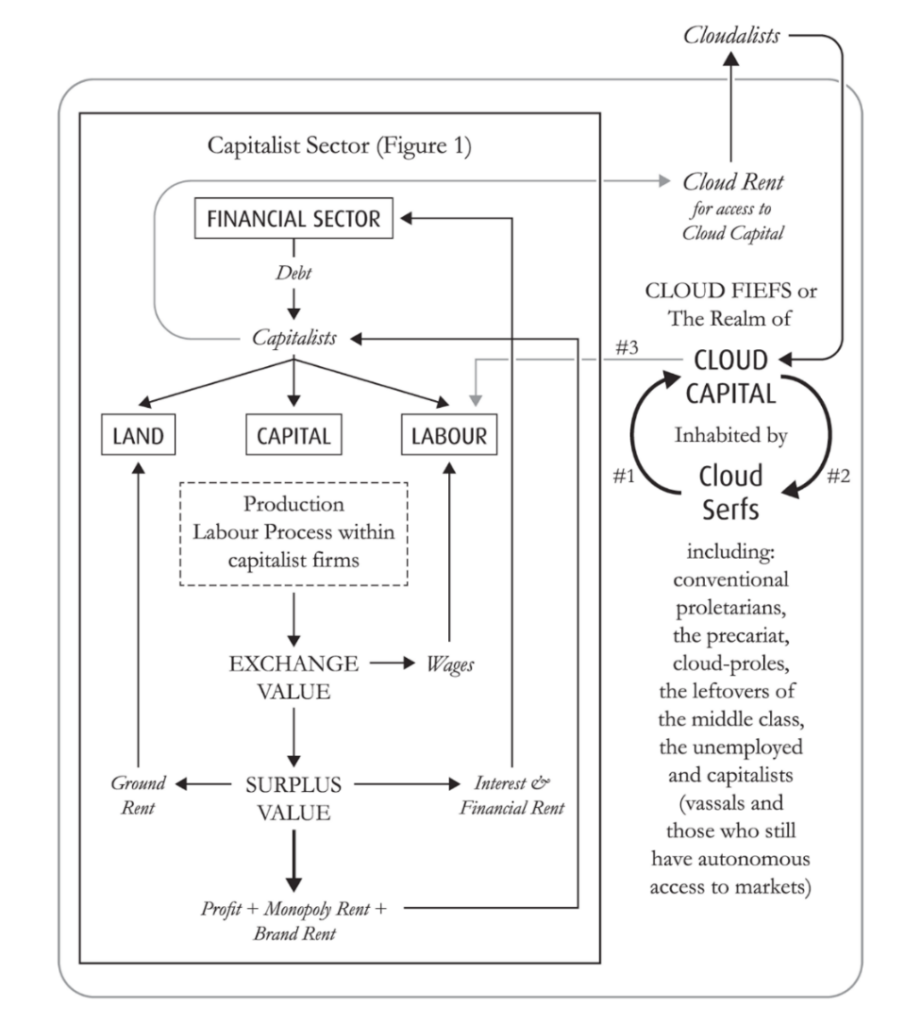
Palantir is a monopoly, as it plays a central role in centralising big data on the US populace. Palantir is a digital platform used on a subscription basis, so it collects cloud rent from a majority of actors, such as vassal capitalists like Boeing and BlackRock, who have no other choice but to use Palantir’s software. Palantir also extracts cloud capital from cloud serfs precisely because it is multi-use. Examples are European care sectors and infrastructure. Not only does Palantir make deals with vassal capitalists, but it also makes deals with large government bodies such as the US state, the Dutch intelligence, and the European Union. This multi-usage model enables Palantir to generate more cloud capital and thus generate more profit. This amount of power makes Palantir function as a quasi-state actor (Jeleweska, 2026).
According to Varoufakis, owners of these digital platforms, ‘cloudalists’, are the new emerging ruling class and can thus wield their newly acquired capital to influence power. This is evident in the large political influence Palantir holds within the US state. Pieter Thiel was one of the first cloudalist to fund Donald Trump’s campaign all the way back in 2016, at a time when Mark Zuckerberg, Jeff Bezos and Elon Musk (all owners of digital platforms) were against Donald Trump (Nayak, 2016). It is no coincidence that J.D. Vance (Pieter Thiel’s apprentice) is the vice-president of the United States. As a privatised defence contractor, Palantir is therefore an intelligence agency not bound to a state, unlike the CIA and the MOSSAD. The next section will examine Palantir’s relationships with state actors.
Palantir and the state
Palantir has been used many times by the US state apparatus. Sarah Brayne (2020) did research on US policing in Los Angeles and how the usage of AI algorithms is biased towards minorities, justifying racist policing. AI having a racist bias has been reported in other instances as well, discriminating against Asian applicants (Levin, 2017). Furthermore, Palantir has been linked to ICE for years. Palantir’s AI is used to track the movement of immigrants (Hubbard, 2025) through an app called ELITE, which determines who and where to raid purely based on unverifiable data (Verhagen, 2026). Herein, ICE is being controlled by the algorithm in choosing who to arrest, illustrating the nature of behaviour control by cloud capital. In this sense, the state acts like a vassal.
Palantir’s influence is not only bound to the United States, but it also has close ties with Israel. Palantir powers AI systems such as ‘Lavender’ and ‘where’s daddy’, that make real-time kill lists of Palestinians (Abraham, 2024), making Palestine a testing ground for these systems to operate. It also has ties in the conflict with Iran, whereby the United States uses Palantir’s software to monitor whether Iran has nuclear weapons and is also in favour of the US war with Iran, as one of the founders of Palantir stated that he could not wait to ‘invest in Iran’ (Ahmed, 2026). War provides a way for Palantir to test their algorithms, but also an opportunity to further enclose the digital commons, thus making the cloud fief bigger. This way, Palantir can gain more cloud capital while also strengthening its nature of behaviour control.
Furthermore, Palantir has contracts with the Norwegian police (Gundhus & Wathne, 2023), the Danish police (Galis & Karlsson, 2024), and the Dutch police (NU.nl, 2025). Palantir is not only expanding its influence in the European security sector but also in the care sector. With Palantir already being established in the UK care sector (Booth, 2025). Recently, it announced a partnership with the Dutch care sector (Kepinski, 2026). It has been revealed that former prime minister Dick Schoof and former head of the Dutch intelligence agency AIVD struck a deal with Palantir as far back as 2011. As part of a project called ‘the raffinaderij’, which is a database of all the Dutch citizens, in an attempt to counter terrorism (BNNVARA, 2025). Further militarisation serves Palantir’s interests, as evidenced by NATO’s 2025 purchase of the MSS NATO system from Palantir (SHAPE Public Affairs Office, 2025). Because these weapons become further entangled in Palantir’s sphere, the question arises whether the Dutch military or any military can act independently from Palantir’s interests (which are tied to US interests for now) at all. The Dutch military is forced to keep using this software because the costs of switching to a different system become too high. The logic of the sunk-cost fallacy dictates that these vassals, paying cloud rent to Palantir, will embrace Palantir’s software in many more facets of society.
Discussion & Conclusion
Palantir does not act alone. There are multiple cloudalists, each owning a different role in the cloudfief. Zuckerberg dominates the fief where we socialise (Meta), Bezos dominates the fief where we shop (Amazon), and Musk dominates the fief of outer space and communication (Starlink). It also has to be noted that multiple cloudalists can occupy a fief at once; there are multiple social media apps, e-commerce and streaming services, yet very few. Palantir’s acquisition of cloud capital works like a loop, amassing more power and influence; it is hard to imagine where its influence will end and to what extent the US government can stop this. Whereas in Varoufakis’s model, Cloudalists extract cloud rent from vassal capitalists and cloudserfs. What makes Palantir different from the other cloudalists is that Palantir goes beyond and extracts cloud rent from whole states. Leading states to become more reliant on Palantir’s software, thereby tightening its grip and ultimately making it inescapable. Palantir owns the most important fief, ‘the high fief’, the fief of governance.
The point of contention is the extent to which Palantir influences the United States government and vice versa. Palantir received funding from the CIA to get started. This makes sense, as Thiel and Karp serve the American empire; if not, the CIA would fund another tech giant. Yet, as seen with Thiel being able to influence the US government with the appointment of JD Vance and supporting Trump, Palantir does have an influence on what decisions get made at the top (Klaidman, 2024). Furthermore, a publication by the Dutch government about the risks of American cloud-capital was deleted because the research was overly enthusiastic about its use (van Rompu, 2026). As of now, it is clear that the US government and Palantir have the same interests. The question then is to what extent the US government can stop Palantir when their interests do not align, and whether it is too late.
To escape the hands of the cloudalists, cloud rent should be made a common good and thus be a digital commons for the interest of the majority, according to Varoufakis. States should free themselves from being vassals. Although this goes beyond the scope of this paper, there is no clear blueprint for achieving this; it is therefore up to the people’s imagination to identify disruptive processes that challenge the technofeudalists.
Lucas Zuidema
Bibliography
Abraham, Y. (2024). ‘Lavender’: The AI machine directing Israel’s bombing spree in Gaza. +972 Magazine. https://www.972mag.com/lavender-ai-israeli-army-gaza/
Ahmed, N. (2026, 5 maart). Palantir’s Double Conflict of Interest in the War Against Iran. Byline Times. https://bylinetimes.com/2026/03/05/palantirs-double-conflict-of-interest-in-the-war-against-iran/
BNNVARA. (2025). Nederlandse overheid gebruikt al jaren omstreden AI-software van Palantir, met dank aan Dick Schoof – Joop – BNNVARA. Joop. https://www.bnnvara.nl/joop/artikelen/nederlandse-overheid-gebruikt-al-jaren-omstreden-ai-software-van-palantir-met-dank-aan-dick-schoof
Booth, R. (2025). Palantir accuses UK doctors of choosing ‘ideology over patient interest’ in NHS data row. The Guardian. https://www.theguardian.com/technology/2025/jul/08/palantir-technology-uk-doctors-patient-nhs-data
Brayne, Sarah, Predict and Surveil: Data, Discretion, and the Future of Policing (New York, 2020; online edn, Oxford Academic, 22 Oct. 2020), https://doi.org/10.1093/oso/9780190684099.001.0001, accessed 6 Mar. 2026.
ECPS. (z.d.). Dark Enlightenment – ECPS. populismstudies.org. https://www.populismstudies.org/Vocabulary/dark-enlightenment/
Galis, V., & Karlsson, B. (2024). A world of Palantir – ontological politics in the Danish police’s POL-INTEL. Information, Communication & Society, 27(13), 2438–2456. https://doi.org/10.1080/1369118X.2024.2410255
Gardner, M. (2026, 17 februari). Palantir Pays Zero Federal Income Tax Despite Explosive Growth, Largely Due to Trump Tax Law. ITEP. https://itep.org/palantir-pays-zero-tax-trump-tax-law-ice/#:~:text=U.S.%20taxpayers%20are%20paying%20multiple,a%20system%20to%20track%20immigrants
Gregg, A., & MacMillan, D. (2020, September 30). Palantir goes public at $10 per share, ending 16 years of privately held secrecy. The Washington Post.
Hubbard, S. (2025, 22 augustus). ICE to Use ImmigrationOS by Palantir, a New AI System, to Track Immigrants’ Movements – American Immigration Council. American Immigration Council. https://www.americanimmigrationcouncil.org/blog/ice-immigrationos-palantir-ai-track-immigrants/
Jelewska, A. (2026). Technoliberalism and platforms as new states. Dialogues on Digital Society, 0(0).
Kepinski, W. K. (2026, 9 februari). AI-reuzen Cognizant en Palantir vernieuwen de zorg. Dutch IT Channel. https://www.dutchitchannel.nl/news/724326/ai-reuzen-cognizant-en-palantir-vernieuwen-de-zorg
Klaidman, D. (2024). The billionaire who fueled JD Vance’s rapid rise to the Trump VP spot — analysis. CBS News. https://www.cbsnews.com/news/jd-vance-trump-vp-peter-thiel-billionaire/
Levin, S. (2021). Palantir to pay $1.7m over accusation it discriminates against Asian applicants. The Guardian. https://www.theguardian.com/technology/2017/apr/26/palantir-racial-discrimination-lawsuit-asians-peter-thiel
Nayak, M. (2016, October 16). Tech investor Thiel to donate $1.25 million to Trump campaign. Reuters. https://www.reuters.com/article/world/us/tech-investor-thiel-to-donate-125-million-to-trump-campaign-idUSKBN12G0ZG/
Palantir. (z.d.). Palantir. https://www.palantir.com/
van Rompu, M. (2026, March 5). Onderzoek naar Amerikaanse cloud-risico’s door ministerie van overheidswebsite verwijderd. De Volkskrant. https://www.volkskrant.nl/binnenland/onderzoek-naar-amerikaanse-cloud-risico-s-door-ministerie-van-overheidswebsite-verwijderd~b086b536/
SHAPE Public Affairs Office. (2025). NATO acquires AI-enabled Warfighting System. Shape.Nato.int. https://shape.nato.int/news-releases/nato-acquires-aienabled-warfighting-system-
Varoufakis, Y. (2024). Technofeudalism: what killed capitalism. Brooklyn, NY, Melville House.
Verhagen, L. (2026, January 18). ICE gebruikt superapp Elite van Palantir voor klopjachten op migranten. De Volkskrant. https://www.volkskrant.nl/tech/ice-gebruikt-superapp-elite-van-palantir-voor-klopjachten-op-migranten~bc5cb5a2/
Yahoo finance. (z.d.). Palantir Technologies Inc. (PLTR). Geraadpleegd op 6 maart 2026, van https://finance.yahoo.com/quote/PLTR/holders/