The F-35 fighter jet, formerly known as JSF, has recently been in the spotlights due to its use by Israel in bombing Gaza. Less attention has been paid to the role of this US fighter jet in European air forces in times of a shifting security paradigm and changing global structures of power.
Although there is a growing political gap between Europe and the United States, the Lockheed fighter continues to gain more position as the backbone of European air power. The F-35 is the most expensive weapon system ever. The US general accounting office (GAO) estimates the total costs for production and overhaul for the US alone (2,470 fighters) at over $2 trillion. The F-35 is not just military hardware. For part of the Western European security elite it is also a tool to strengthen the ties with Washington so that the US will continue to be military involved in the old continent.
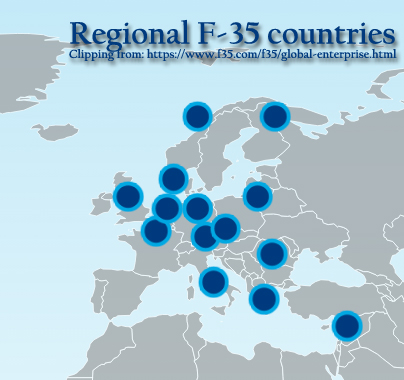
The map shows how the F-35 is spread across Europe. Many of these countries also share in F-35 production, to tie them not only military but also economically, comparable to the way production in the US is spread over a large number of states to get its representatives in Congress and Senate tied to the project.
To buy or not to buy
NATO-Europe and EU countries like Belgium, Czechia, Denmark, Finland, Greece, the Netherlands, Norway, and neutral Switzerland have all ordered the F-35. Orders also come from countries with indigenous fighter production: the (German\Italian\ French\British) Eurofighter, the (German/French/Spanish) Future Air Combat System FCAS and the (British/Swedish/Turkish) Tempest. Only France and Spain stay out of the F-35 acquisition spree, as well as Sweden with is own Gripen fighter jets.
Turkey has been trying for years to buy the F-35 (while locally working on the KAAN fighter).
At the same time, the newly developed European fighters FCAS and Tempest are running into trouble; and the European position on the extremely important international fighter market stays weak compared to the US which also has more fighters on sale besides the F-35. This is not only caused by nationally divided production in Europe, but is also the result of political choices to keep the US glued to Europe. For smaller countries it is a way to counterbalance with Washington against Berlin, London and Paris. But is this wise? Even in the security establishment, the reliability of the US administration is seriously questioned. A Foreign Policy columnist recently bluntly remarked ‘NATO’s Leader Is Totally Lost’ and rhetorically asked: ‘What does Mark Rutte think he’s doing?’
The US northern neighbour Canada, is openly reevaluating the purchase of F-35’s because of souring relations. (Although silently Ottawa seems to be giving in.) In Switzerland, major political Swiss Socialist Party declared that they “will not support a special defence budget that includes the controversial US F-35 fighter jet as a major budget item.” But past upheavals show that the F-35 will not be stopped. In general, countries speak up but do not change course over this purchase. As if the world still is the same as a decade ago .
Long term dependency
The acquisition of the F-35 by NATO-Europe and EU countries is also in the interest of the US. Selling arms, especially major weapons like fighter jets, creates long term dependencies on the customer side.
One of the issues regularly discussed recently is the ‘kill switch’ on the F-35 so the the US can ‘switch it off’ from a distance. Amongst others European Parliamentarian and former French military intelligence director Christophe Gomart claimed the existence of this kill switch, comparable with backdoors in communication software which gives e.g. governments remote access to a computer or communication. But German Minister for Defence Pistorius said he cannot believe a kill switch to be part of the Lockheed fighter jet as this would mean a complete collapse of US arms exports. Dutch former Commander-in-Chief Dick Berlijn said: “I do not believe in a kill switch (…) But the Americans could also frustrate the deployment of the plane in other ways, for example by ending weapon supplies. Or halting software updates.” https://www.nrc.nl/nieuws/2026/01/16/we-gaan-niet-met-f-35s-of-mariniers-vechten-tegen-de-amerikanen-dat-leggen-we-altijd-af-a4917727
Tyler Rogoway of the War Zone wrote in a long article on this issue: “You don’t need a ‘kill switch’ to severely hamper the utility of an exported weapons system, you just stop providing support for it and it will wither away, some systems very quickly. The more advanced the faster the degradation.”
Another issue is the source code to the fighter, which is secret, so Europe is not able to adept it to the use of other than US weapons without help and the green light from Washington. These kill switch, update and adaptability issues are similar with other major weapons (e.g. missiles) acquired in the States.
The end of Trump era?
The proponents of military cooperation with the US argue that Trump is not Washington and that his reign will come to an end. They claim there are also other tendencies in the Pentagon and Democrats may follow another policy. One of the examples is John F. Kerry, who wrote an guest essay in the New York Times in which he complained about the policy of the current Administration. One of his grievances is that Trump endangers the arms sales to Europe, a continent which buys 35% of all US arms, making Europe the commercial military enterprises’ largest regional customer. (Europe is closely followed by the middle East (33%) and Asia and Oceania received 28% per cent of US arms exports in 2020–24). Apparently Kerry underestimates the European addiction to US major weapon systems.
Annalists who warn against the dependency on the US point at several issues. Besides the threat towards Greenland, there is also the recent National Security Strategy (NSS) published by the White House. This document is full of white supremacy visions (and even Great Replacement theory), denies the climate crisis and openly threat with US intervention in social political discourse in European nations. The European Union is portrayed as an enemy of political liberty and sovereignty and a proponent of migration policies “that are transforming the continent and creating strife, censorship of free speech and suppression of political opposition, cratering birthrates, and loss of national identities and self-confidence.” The White House is ready to help tackling these threats and intermingle in European politics. It will do this not for free, but for unhindered entrance to European markets.
One can argue the NSS is published by the White House under Trump and that Trump is a temporarily aberration. There is however also a recent Pentagon report: the National Defence policy. This more military driven paper ranks threats and missions: Defending the US Homeland and deterring China comes on top. Everything else, including Europe, is secondary. And even article 5, the holy grail of NATO, is not longer guaranteed. The text promises “limited support from the United States” and “we [the USA] must—and will—prioritize defending the U.S. Homeland and deterring China.” As for the Russian threat: “Moscow is in no position to make a bid for European hegemony. European NATO dwarfs Russia in economic scale, population, and, thus, latent military power.” (Note how this contrasts with the advise of Mark Rutte to adversaries of 5% BNP European military spending that they better “should start to learn Russian”. The US policy change is not limited to the White House. The policy to leave Europe to itself will not disappear when the Trump regime comes to an end (if it does).
A fresh European look
The current US government sees no difference between foreign policy and trade deals. The subtlety herein is exchanged for mercantilism as existed before the First World War. The notion is that one does not find friends at the market square. The Trump administrations stepped in this direction in an executive prioritising weapons sales Washington has embarked on what Trump described as an “America First Arms Transfer Strategy.”
NATO spokesperson Rutte follows the Trump route to to keep the major NATO member on board and the Alliance afloat. Why NATO member states continue to sponsor the US military and its industry is harder to understand. Currently, European countries are depending on Lockheed, Pratt & Whitney and other big US military companies to keep one of their most important military assets in the air. While for White House, they are just vassals: used when needed and forgotten when this suites better.
Now is the time to reconsider F-35 acquisitions. It is also time for a fresh look at European peace and security policies. At present they are dictated by a USA on a global confrontation course. It is now the moment for Europe to change in another direction. That does not mean raising military budgets to the excessive US military spending standard, at the cost of welfare, education and civil infrastructure, but a policy away from confrontation, using diplomacy, nuclear disarmament and strict arms (export) control. Europe should leave the dangerous military escalation road that the Trump administration is pushing us to.
Martin Broek February 2026
Extra: Dutch involvement – example of F-35 co-production
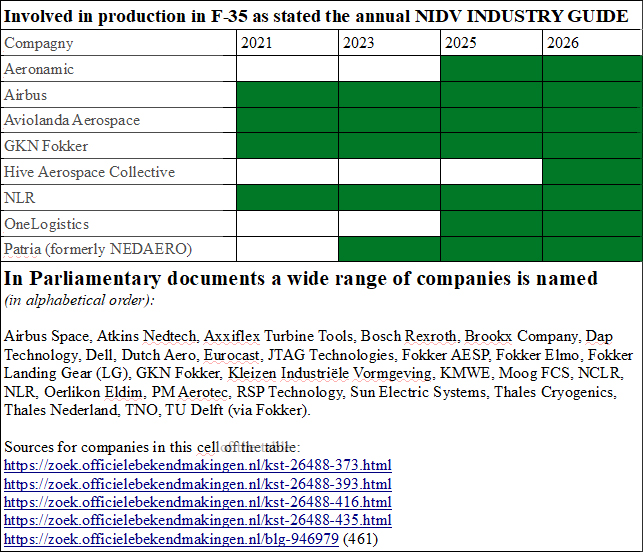
Recently the Netherlands Industry for Defence and Security (NIDV) published its Industry Guide for 2026. The NIDV is the stakeholder platform and lobby organisation for the Dutch military industry and ‘security’ sector and operates mainly in the Netherlands but also internationally.
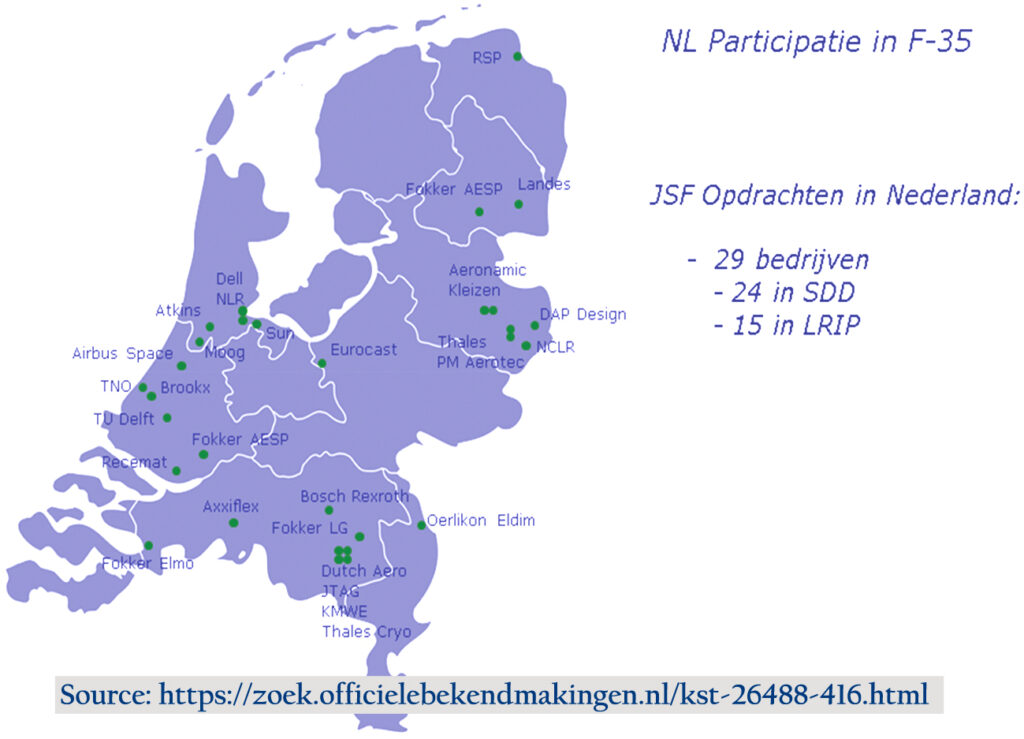
A number of Dutch companies work on the F-35. This participation is widely questioned by campaigners since the F-35 deployment of Israel during its attacks on Gaza and neighbouring countries. It turned out that the Netherlands has no control over the export of its F-35 components and Dutch products end up in violations of human rights and international law. The control of Dutch products is in Washington.
Also mentioned is Airbus involvement (with Dutch research organisation NLR) in the F-35 by providing an “embedded training system for fighter aircraft (E-CATS),” and states this“application enables F-35 fighter pilots to train securely against realistic constructive threats anywhere, anytime.” With the same system Airbus is involved in the EFA and FCAS fighter programs.
According to the NIDV, eight entities with facilities in the Netherlands are presently working on the F-35. They are located across the country and despite the controversies around the F-35 their numbers is growing.